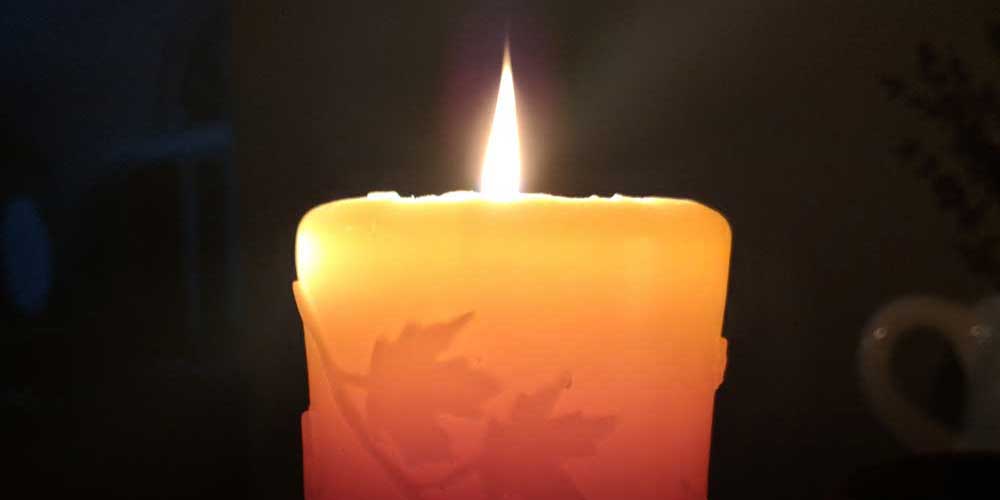
I started burning scented candles when I was fourteen, and it didn't take long to become an obsession. I was a collector. At one point I had several hundred brand-new candles waiting their turn — a candle for every season and every mood. I loved the variety, and I burned them every single day.
By the time I was nineteen, the migraines started.
They got worse over the years — more severe, more often. I went from doctor to doctor, was put on pain medication, and carried it everywhere I went. Every doctor told me the same thing: keep a journal, look for the pattern, find the trigger. So I tracked everything. They ruled out hormonal shifts. They ruled out food intolerances. One by one the obvious suspects came off the list until the only thing left was stress. I was even put on a preventative migraine medication — it didn't work, so I stopped and went back to just managing the pain.
The breakthrough came years later, in a doctor's office at UCLA. She ran through everything the others had and landed in the same place — stress — and I told her that couldn't be it. I got migraines even on the days I was doing nothing but relaxing at home, burning my candles.
She stopped. She asked me about the candles. Were they scented?
“Of course they're scented,” I said. “Is there any other kind?”
She asked me to stop burning all candles for one month and see what happened.
That month, I didn't get a single migraine. I'd normally have had two or three. After nearly thirty years of burning scented candles every day, it had never once occurred to me — or to any of my doctors — that the thing I loved most was the thing making me sick. Scented candles were the last suspect I'd ever have named, so I never even thought to mention them.
I was relieved to finally know. I was also, I'll admit, a little heartbroken. Burning candles wasn't just something I did — choosing the fragrance, matching it to the season or my mood, that was the whole ritual. And now I had to give it up.
It turns out I wasn't unusual
Here's something that surprised me almost as much as the diagnosis: I was far from alone. Research cited by the National Institutes of Health has found that about one in three people — 34.7% — react badly to strong fragrances, with headaches, migraines, or respiratory trouble. The Mayo Clinic lists strong smells among common migraine triggers, and the American Migraine Foundation notes that an aversion to odors is itself a common migraine symptom. A lot of people are sitting in a scented room feeling awful with no idea why. For almost thirty years, I was one of them.
The candle I'd ignored my whole life
I'd heard of unscented candles, and I'd heard of beeswax. I wasn't interested in either one. The fragrance had been the entire point for me, and a plain candle felt like no candle at all. But I missed burning candles badly enough that I finally, reluctantly, tried beeswax.
It didn't trigger a single migraine. That was an enormous relief.
It was also, at first, kind of boring to me — none of the fragrance variety I'd built my whole hobby around. But it was beeswax or nothing, so I stuck with it.
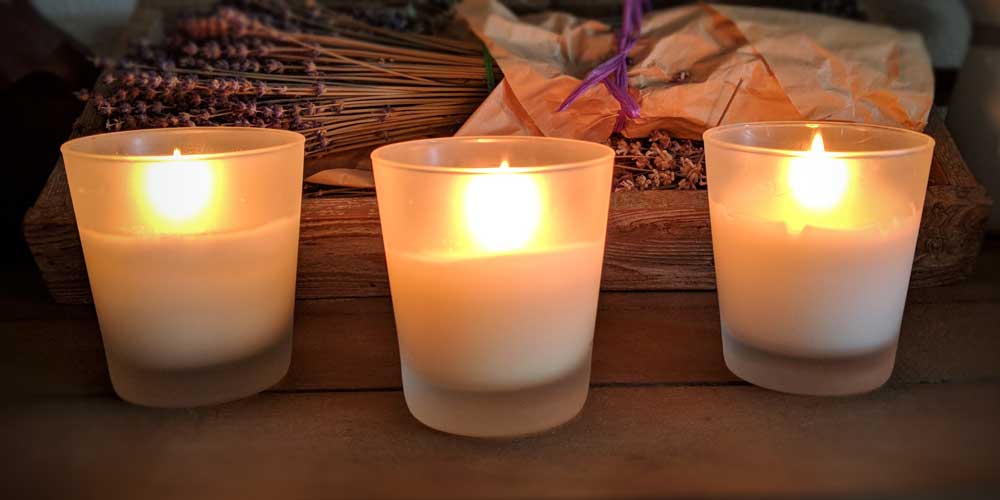
And then I figured something out. The variety I missed didn't have to come from scent. I started burning beeswax tealights in pretty glass holders, and the holders became my variety. Then I added votives. Then tapers. Then pillars, with their carved designs. The variety I thought I'd lost forever came right back — it just came from the shape and the design and the light instead of from a fragrance label.
Beeswax does have a scent, by the way — a soft, warm honey smell that's noticeable but never overpowering. The difference is that it comes from the bees, not from a bottle. Nobody added it.
If you think you might be one of the three
The culprit isn't the wax type — it's the added fragrance. Even some beeswax candles have synthetic scent mixed in. So read the label. Watch for the words “fragrance” or “scent” in the ingredients. A truly pure beeswax candle lists exactly one thing: beeswax. And if you've ever wondered why “fragrance-free” and “unscented” don't mean the same thing — because they really don't — we wrote a whole post on that.
I'm not here to tell you every other candle is bad. The world is full of beautiful candles, and if you're one of the lucky people who can burn them, I envy you. But if you've been quietly suffering and never once connected it to the candle on your table, I hope this saves you the thirty years it took me.
If you'd like to try a candle that won't trigger you, our pure beeswax tealights are where most people start — small, simple, and easy to pair with whatever holder catches your eye.
Author: Kari Lien, Chief Chandler @ Big Moon Beeswax
Sources
• Fragranced consumer products: exposures and effects from emissions — Anne Steinemann, Air Quality, Atmosphere & Health (2016). DOI 10.1007/s11869-016-0442-z — https://link.springer.com/article/10.1007/s11869-016-0442-z
• Mayo Clinic — strong smells listed among migraine triggers (migraine symptoms-and-causes page on mayoclinic.org).
• American Migraine Foundation — “Top 10 Migraine Triggers and How to Deal with Them,” on odor sensitivity. https://americanmigrainefoundation.org/resource-library/top-10-migraine-triggers/